Problem Solving
The Illusion of Rationality
Why more data does not remove uncertainty — or the need for judgement.
High-performance sport has never had more information. Athletes are monitored through GPS, force plates, medical systems, video, wellness tools and laboratory testing. Coaches receive dashboards, reports and analytics. Organisations invest heavily in data platforms, artificial intelligence and increasingly sophisticated decision-support systems.
The logic is compelling. If we can see more, measure more and analyse more, surely we should understand more — and make better decisions. Yet beneath the data revolution sits an uncomfortable question: are we actually becoming more rational, or are increasingly data-rich environments creating the appearance of rationality around decisions that remain fundamentally human acts of judgement?
Solving is not deciding
In The Problem With Problem-Solving, I argued that problems and decisions are related but different. Problem-solving is concerned with understanding what is happening and developing possible solutions. We may need to establish why something has occurred, determine which information matters, reconsider the way the problem has been framed, or create and adapt a response that does not yet exist.
Decision-making occurs when we have to exercise judgement between possible courses of action and commit. Do we change the programme? Does the athlete compete? Which player starts? Do we accept the risk? Which intervention do we pursue?
Decisions occur throughout problem-solving, but developing possible solutions and judging which course of action to take are not the same cognitive task. This distinction matters because data and technology are frequently described as improving decision-making when what they usually provide is additional information. Somebody still has to interpret that information, decide how much weight to give it and judge what should happen next.
Humans do not make those judgements like computers.
We were never perfectly rational
Decision science has spent decades challenging the idea of the perfectly rational decision-maker. Humans move between relatively fast, intuitive thinking and slower, more deliberate reasoning. We use heuristics — simplified rules, patterns and mental shortcuts — because our attention, time and capacity to process information are limited. Herbert Simon described this constraint as bounded rationality.
We cannot possess unlimited information, process every possible variable or perfectly calculate the consequences of every available course of action. That does not make intuitive judgement inherently inferior. Experienced coaches and practitioners can become extremely good at recognising meaningful patterns, identifying important cues and accessing responses developed through experience. Equally, intuition can mislead us when experience is limited, environments are unstable or the patterns we believe we recognise are unreliable.
The useful distinction is therefore not simply between fast thinking and slow thinking. Good judgement requires recognising what kind of thinking the situation requires, what information deserves attention and when further analysis is unlikely to change what we do.
The complication is that we have now built performance systems that give us more to think about than ever before.
More information, more complexity
Consider the coach. A coach may be trying to understand an athlete while simultaneously considering training history, physical readiness, technical performance, tactics, opposition, health, psychology, recovery, competition schedules and what they have observed with their own eyes. Around that athlete sits an expanding network of expertise, each practitioner viewing the problem through a different professional lens.
The sport scientist may see training load. The physiotherapist sees function. The doctor sees health and risk. The strength and conditioning coach sees physical capability. The analyst sees performance behaviours. The psychologist may recognise something entirely different about readiness, confidence or behaviour. Increasingly, each of these specialists also brings their own technologies, datasets, dashboards and models.
None of those perspectives has to be wrong, but none is complete. The coach sits somewhere within this ecosystem trying to make sense of biological, technical, tactical, psychological, interpersonal and organisational factors that continually interact. They also have to account for the athlete in front of them, the context in which the decision is being made and the consequences of being wrong.
Technology can help enormously. Better information can reveal patterns we could not previously see, challenge intuition and improve the questions we ask. But every additional source of information can also introduce another metric, another interpretation, another professional perspective and another potential silo. Data may be accumulated within medical systems, performance systems, analysis platforms and discipline-specific tools, each providing a legitimate but partial representation of reality.
We built technology partly to help us contend with complexity. Sometimes it also gives us more complexity to contend with.
A thin slice of the truth
Data is valuable precisely because it allows us to see things that would otherwise remain hidden. The problem begins when what can be measured starts to look like everything that matters. A dashboard may tell us very precisely how much an athlete ran yesterday, but it cannot by itself tell us what they should do today. A physical test may quantify an important characteristic without describing the whole athlete. A model may estimate risk without accounting for everything that will happen next.
Data therefore gives us a thin slice of reality — sometimes an exceptionally useful one. But precision should not be confused with completeness, and confidence should not be confused with certainty.
My research with leaders in high-performance sport repeatedly exposed this tension. Leaders are expected to provide direction, make decisions and communicate confidence while working in environments characterised by uncertainty, risk and incomplete information. Data can strengthen the confidence with which a judgement is made, but it cannot always justify certainty about the outcome.
This distinction becomes harder to see when information is presented with apparent precision. A number displayed to two decimal places looks certain. A dashboard organised into green, amber and red looks decisive. A predictive model appears objective. Yet every model knows only what enters it, every dashboard represents choices about which variables matter, and every number describes one element of a much larger system.
Data can increase confidence without increasing certainty.
There is also a retrospective trap. Once an outcome is known, sufficiently rich datasets make it remarkably easy to look backwards, identify signals and construct a convincing explanation for why something happened. The explanation may be reasonable, but that does not mean the outcome was knowable prospectively or that those same variables would have carried the same importance beforehand.
Sometimes data does not eliminate uncertainty. It simply gives uncertainty a decimal point.
When optimisation becomes impossible
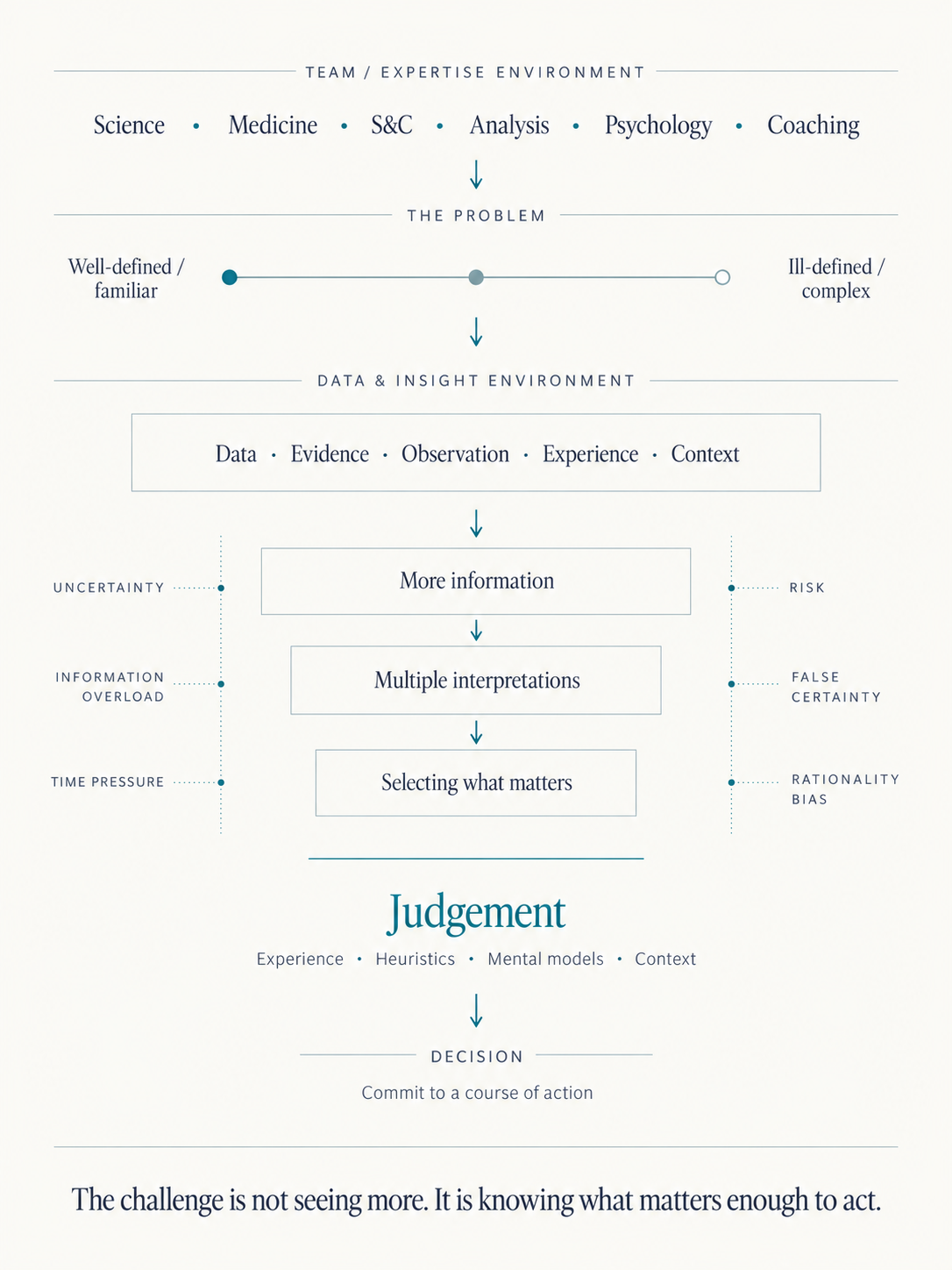
This brings us back to bounded rationality. The rational ideal suggests that we gather all relevant information, accurately weight the alternatives and calculate the optimal course of action. In a complex performance environment, however, that ideal quickly becomes difficult to sustain. There may simply be too much information to process, too many interacting variables, too little time and too much that remains unknown.
In practice, humans frequently satisfice. We draw on the evidence available to us alongside experience, heuristics, mental models, context and professional judgement. Rather than mathematically proving that a particular option is optimal, we arrive at a course of action that is sufficiently credible to move forward.
My research with practitioners and leaders in high-performance sport repeatedly exposed this reality. People are expected to make defensible, evidence-informed decisions while recognising that they can never know, process or appropriately weight everything that might matter. This is especially important when risk and uncertainty cannot be removed and waiting for more information carries its own consequences.
Eventually, somebody has to act. The coach selects the team. The clinician makes the recommendation. The practitioner changes the programme. The leader commits resources. More analysis may improve those judgements, challenge assumptions or change the available options, but it cannot remove the moment when somebody has to decide: this is what we are going to do.
The scarce capability is judgement
Perhaps this is the more interesting consequence of the data revolution. As information becomes increasingly abundant, the scarce capability may no longer be obtaining data. It may be determining what matters enough to influence what happens next.
Which metric deserves attention? Which change represents signal rather than noise? Which specialist should influence this decision? How relevant is the available evidence to this athlete, in this context, today? Which assumptions are we making? What information are we missing? How much uncertainty can we tolerate? At what point does further analysis stop improving the judgement and simply delay action?
These are not primarily questions of data collection. They are questions of judgement.
They also connect directly to the wider argument of Blended Intelligence. Once we accept that no individual can see or process everything, we have to consider whose expertise a problem requires, which perspectives need to interact and how that expertise should be organised. cognitive diversity may broaden what we can see. Adaptive Teaming may help us configure expertise around the demands of the problem. Leadership can create the conditions in which specialists are able to think, challenge and contribute. None of these removes judgement; they create a better environment in which to exercise it.
Blended Intelligence is therefore not an argument against data, technology or analytical reasoning. Quite the opposite. These tools can dramatically improve what we know and extend what individuals and teams are capable of seeing. The danger comes when better information is mistaken for complete understanding, or when the apparent objectivity of technology allows us to pretend that judgement has somehow been removed from the process.
Data helps us see. Technology helps us organise and analyse. Expertise helps us interpret. But uncertainty remains, and somebody still has to determine what matters, decide how much confidence is justified and commit to what happens next.
More information does not remove the need for judgement. It raises the standard required of it.
Related Ideas
The Problem With Problem-Solving
Why better solutions start with understanding the problem.
Too Many Cooks or Many Heads?
Why more expertise, more diversity and more collaboration are not always better.
The Collaboration Trap
Why the best teams don’t always work together more.
Creating the Conditions
Why leading expertise is less about having the answer and more about enabling better thinking.
It starts with the problem.
Blended Intelligence helps leaders and organisations understand complex problems, organise the right expertise and create the conditions for better solutions.
Ryan King is a high-performance leader, researcher and founder of Blended Intelligence. His work explores how organisations, leaders and multidisciplinary teams solve complex problems, organise expertise and create the conditions for sustained performance.